History of the Lodge
A Lodge Older Than the County Seat
Johnson City Lodge No. 561 received its charter on December 16, 1882. Our story is intertwined with that of Johnson City itself.
1882
The Charter
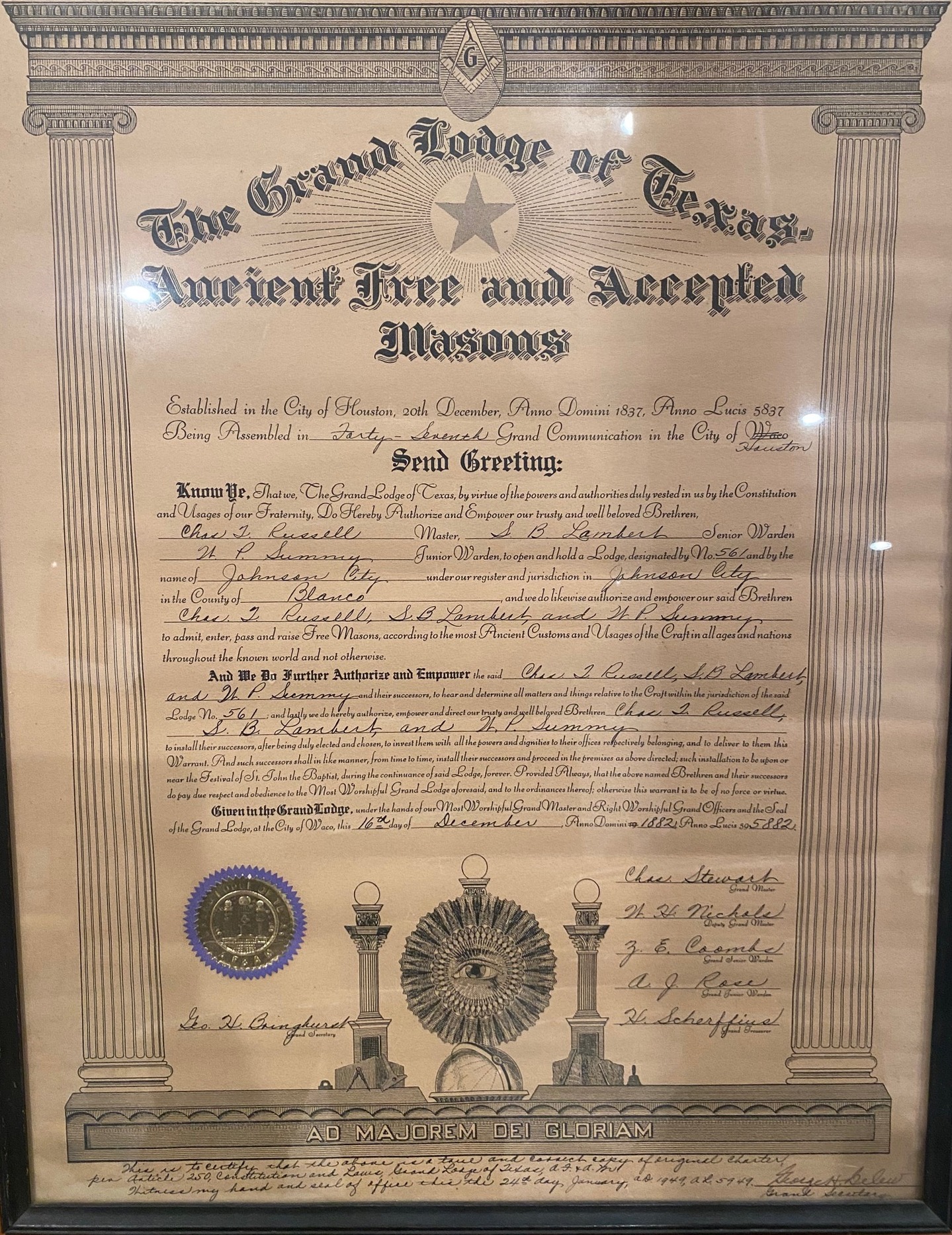
On December 16, 1882, the Grand Lodge of Texas granted a charter to a body of brethren in the young town of Johnson City — a settlement barely a decade old, named for James Polk Johnson, the man who had laid out its streets just a few years before.
From the start, the lodge was bound up with the life of the town. Its first members were among the merchants, farmers, ranchers, and tradesmen who built Johnson City and its institutions, and the lodge served not only as a fraternal home but as a quiet civic anchor in a frontier county.
A Founding Brother
William McCarty (1827–1889)
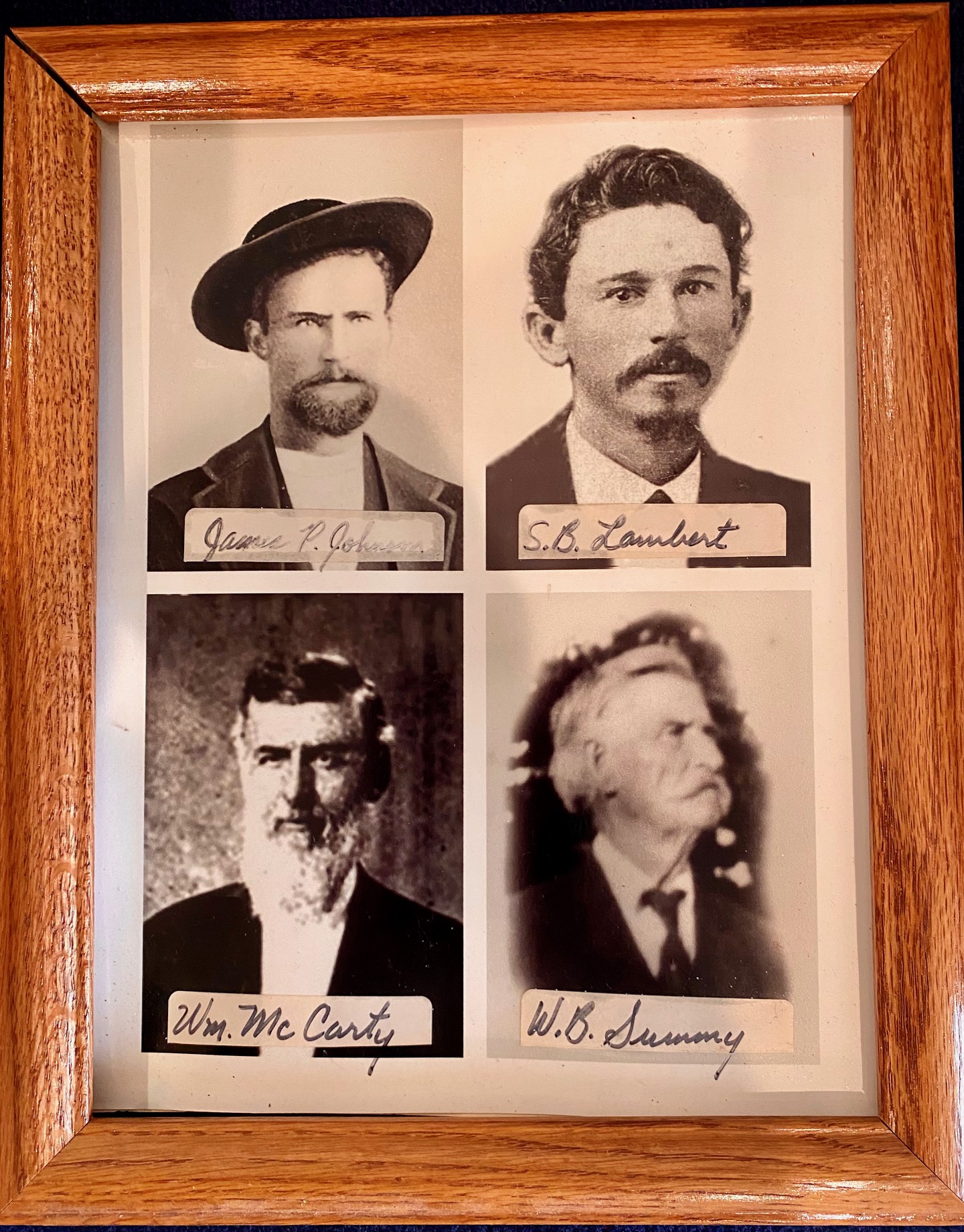
Among the brethren who organized Lodge No. 561 in 1882 was William McCarty — pioneer cattleman, family patriarch, and one of the lodge's first Worshipful Masters.
McCarty had settled along the Pedernales River in Blanco County by the late 1860s, raising cattle on the open range and building a ranch that became a known landmark on the road through the Hill Country. With his wife Mary "Emeline" Whatley (1838–1917), he raised five children — Cornelia, Paul, Guy, Stella, and Maxwell — names still familiar in Blanco County genealogies.
When local Masons petitioned the Grand Lodge of Texas in 1882 for a charter, McCarty was among them. Within a few years of receiving it, he served as Worshipful Master of the new lodge — earning the title of Past Master that he carried for the remainder of his life.
It was a short remainder.
On April 15, 1889, while trailing his herd toward New Mexico, McCarty was shot and killed by cattle rustlers at Crow Springs, outside Roswell. He was sixty-two years old.
There is a quiet irony in his story: William McCarty helped found the lodge that, three years after his death, would purchase land from Julia Ann Moore Johnson and establish the Masonic Cemetery in Johnson City. The cemetery now holds many of his fellow charter brethren and their families. McCarty himself rests where he fell, near the New Mexico border.
His sons remained in Blanco County. The McCarty name lived on in ranching, in the lodge's records, and in the slow, steady work of building a community out of frontier ground.
1876–1890
The County Seat Heist
For fourteen years the brethren and citizens of Johnson City carried on a slow, patient, occasionally exasperating campaign to do something audacious: to take the county seat away from the town of Blanco and install it here, on the higher ground at the bend of the Pedernales.
The fight began in 1876, the year Blanco County was reorganized after the Civil War. It was waged by petition, by stump speech, by Sunday-after-church argument, and by election. It was lost, then lost again, then lost a third time. Each loss only sharpened the next campaign.
In 1890 it was finally won. Johnson City became the county seat of Blanco County. The Masons of Lodge No. 561 had been in the thick of it from the start — not as a political body (the lodge keeps its own counsel on such matters) but as the town's leading citizens acting, severally, on a shared instinct that the work of a county ought to be done in the place where the work was already getting done.
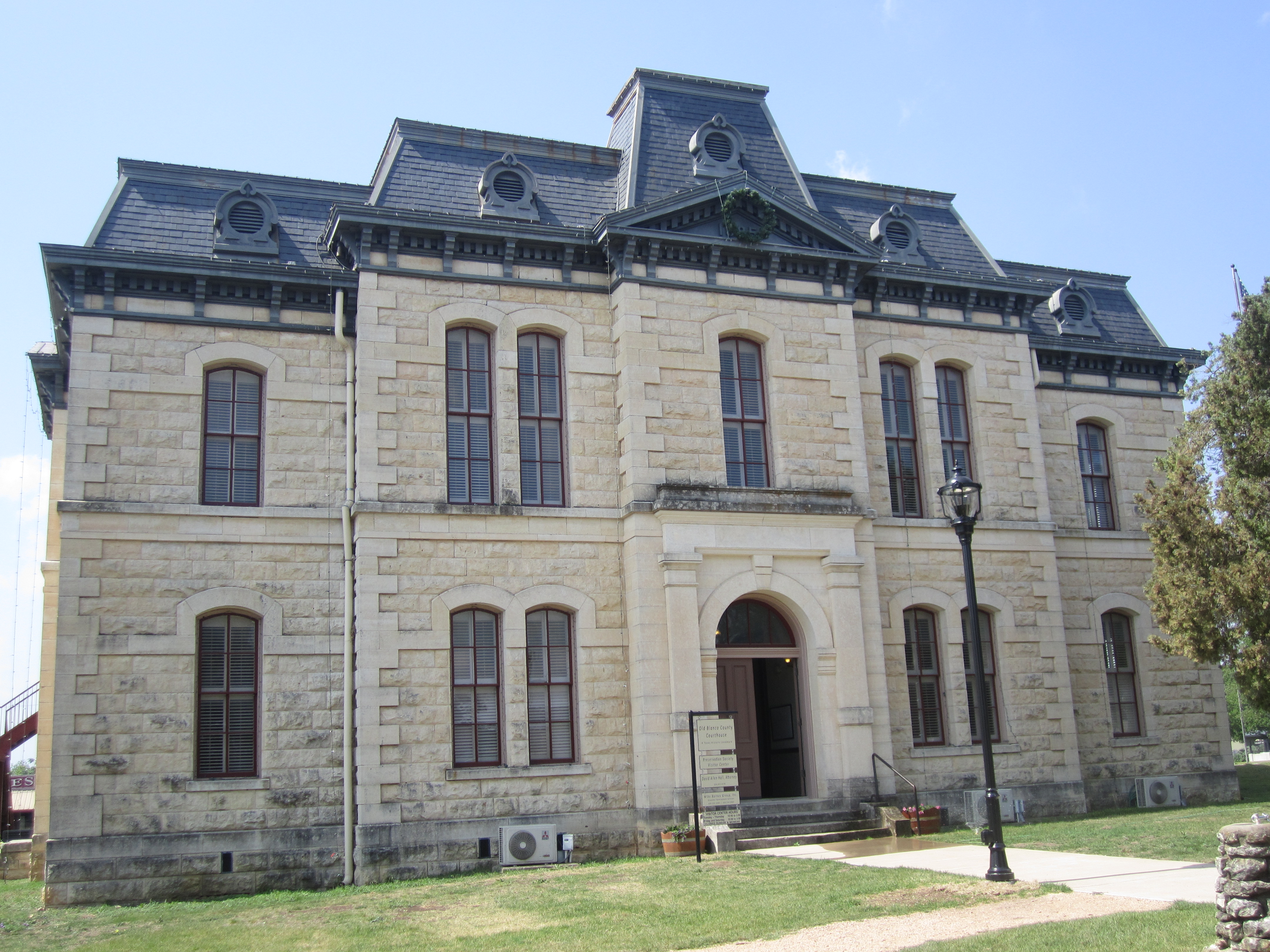
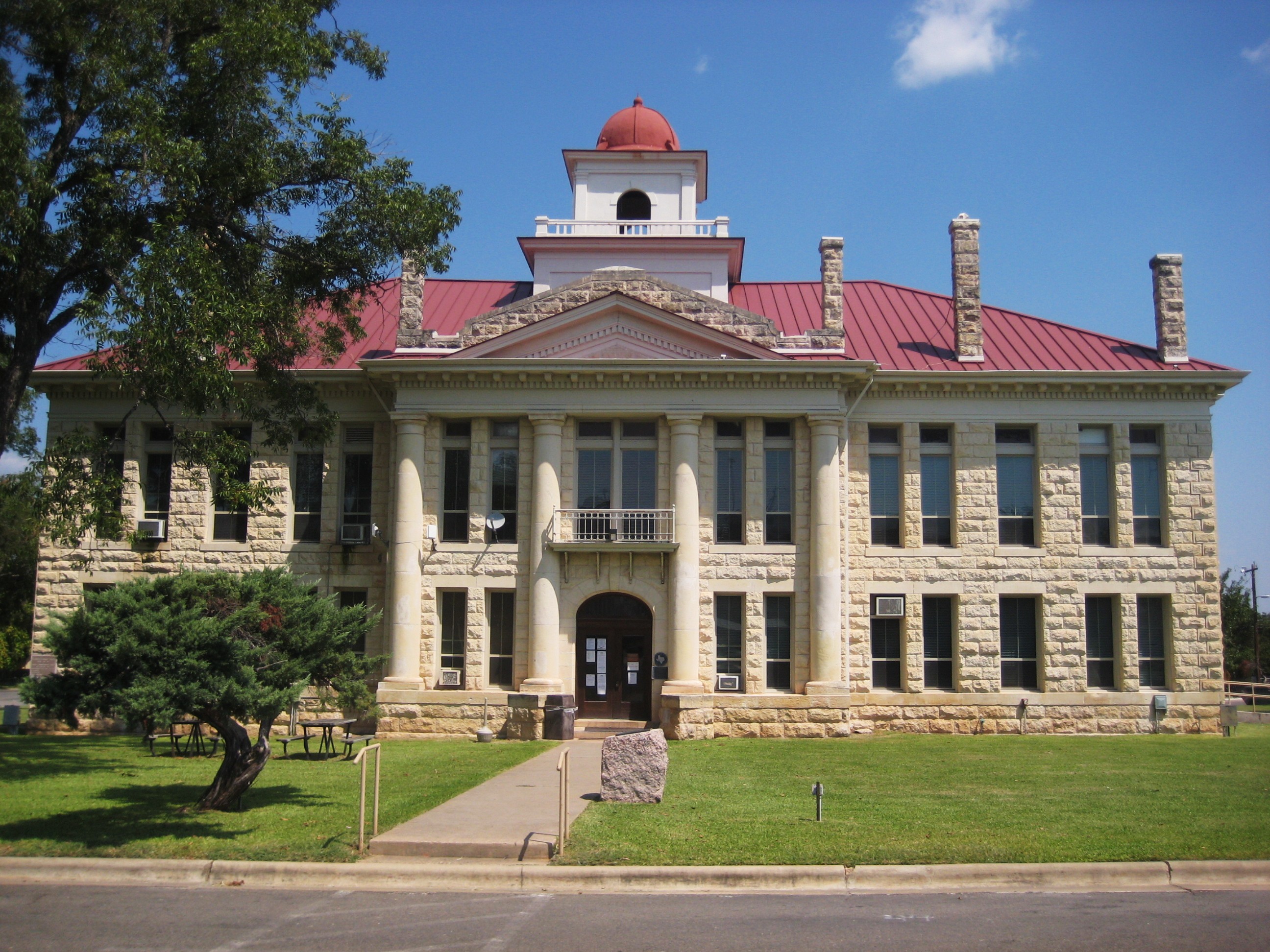
Photographs from Wikimedia Commons. Old Blanco courthouse: Billy Hathorn, CC BY 3.0. 1916 Johnson City courthouse: Travis K. Witt, CC BY-SA 3.0.
A Worshipful Master, Eight Times Over
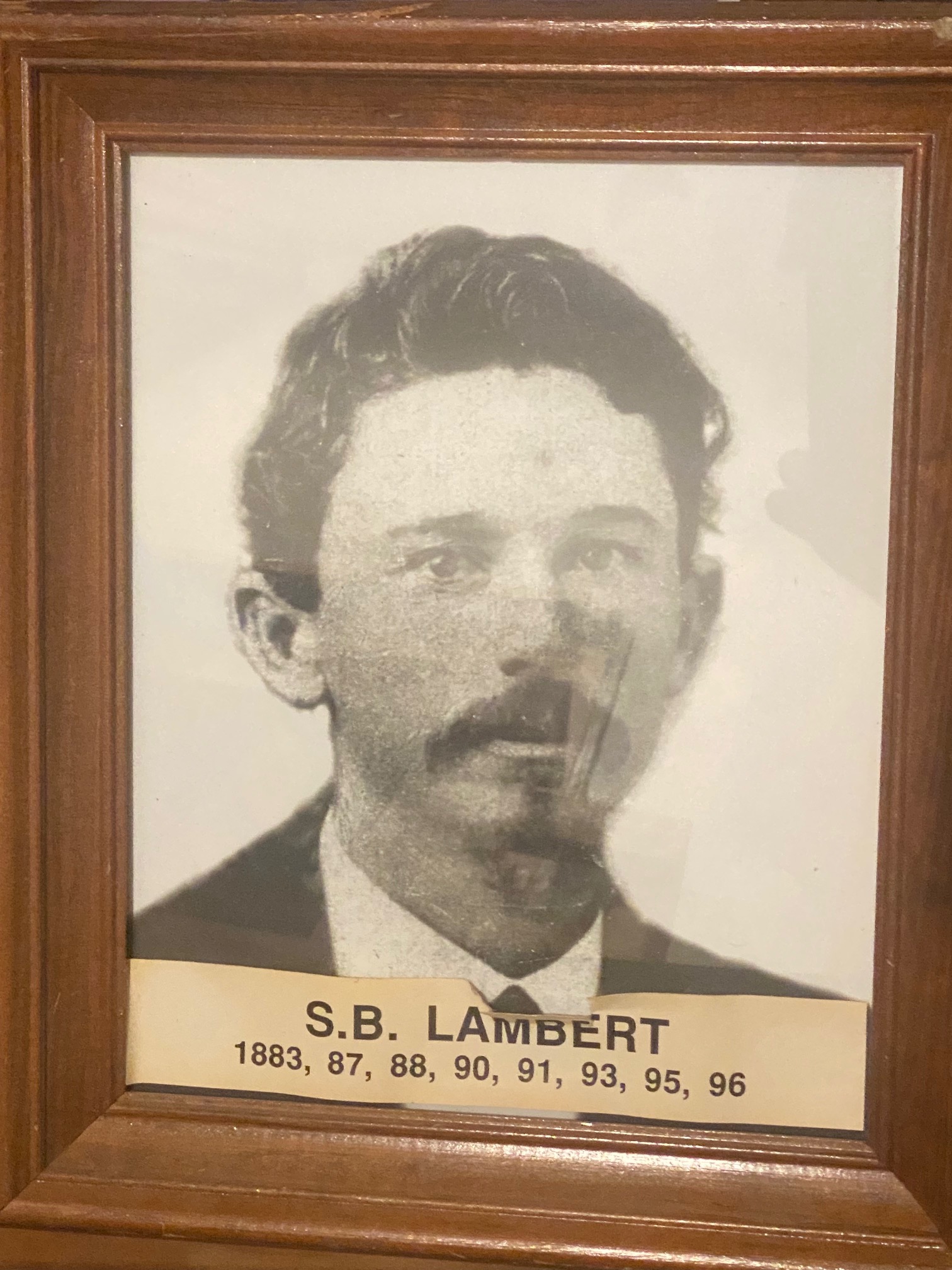
Samuel B. Lambert (1847–1904)
Samuel B. Lambert was born December 15, 1847, in Gonzales County — a second-generation Texan, son of the Tennessee pioneer Thomas Lambert and Mary "Pollie" Nobles. By the time the Civil War ended he was a young man on the frontier; by the early 1870s he had married Margaret Jane Bass and pointed his life toward the Texas Hill Country.
They settled in Blanco County in the mid-1870s, on a homestead in the Pedernales River valley. Johnson City was then barely a town — a place laid out by James Polk Johnson and named for him in 1879. Lambert became one of its pioneer settlers, raising cattle, raising children (seven in all: Jess, Lula, Edgar, Mattie, Grover, Walter, and an infant lost in 1898), and helping the new community find its feet.
He served as Worshipful Master of Johnson City Lodge No. 561 eight times.
Lambert was a founding member of Lodge No. 561, chartered in late 1882. Within a year he was in the East. He returned to it in 1883, 1887, 1888, 1890, 1891, 1893, 1895, and 1896 — a record of trust and dedication unmatched in the lodge's first half-century. Some men sit in the East once and consider the labor done. Lambert sat in it again, and again, and again, the way a rancher returns to mend the same fence each spring because the fence is what holds.
The minute books do not name Lambert by name in the political fight that finally won Johnson City the county seat in 1890. They didn't have to. He was Worshipful Master that year. He was Worshipful Master the year before, and the year after. When the town that built itself around the lodge moved its courthouse to Johnson City, the man in the East of Lodge No. 561 was Samuel B. Lambert.
He fell ill in 1904 and died on October 31 of that year, age fifty-six. He is buried in the Johnson City Masonic Cemetery, alongside many of the brethren whose terms in the East he so quietly outnumbered. His widow Margaret outlived him by twenty-eight years. His son Walter Tips Lambert served in France with the 36th Division's 142nd Infantry in the First World War, came home, and lived out his days in Johnson City. The Lamberts stayed.
1892
The Cemetery
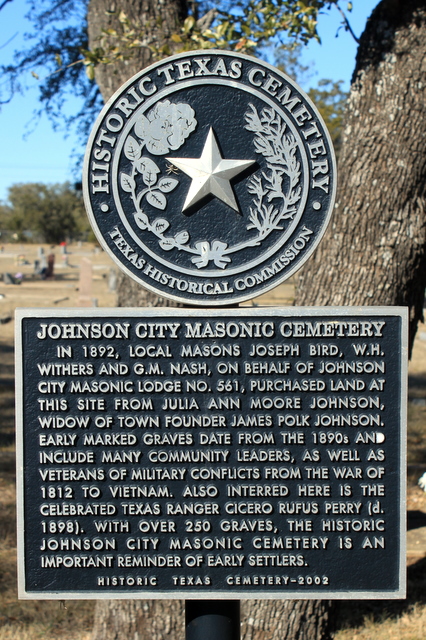
Ten years after the lodge was chartered — and three years after William McCarty's death on the cattle trail — brethren Joseph Bird, W. H. Withers, and G. M. Nash, acting on behalf of Lodge No. 561, purchased the land that became the Johnson City Masonic Cemetery from Julia Ann Moore Johnson, the widow of James Polk Johnson, the town's namesake and founder. The deed bears the date of 1892.
More than 250 graves rest there now — community leaders, veterans of conflicts from the War of 1812 to Vietnam, and the celebrated Texas Ranger Cicero Rufus Perry (d. 1898). The Texas Historical Commission designated it a Historic Texas Cemetery in 2002. The lodge has cared for the ground continuously since 1892. It is now also the site on which our new lodge home is rising.
A Lineage of Four Homes
Four Buildings, One Lodge
A lodge is not a building. A lodge is brethren working together — and the building is only the roof we keep over that work. In one hundred and forty-three years, Lodge No. 561 has kept the work going under four roofs.
A lodge isn't a building. A lodge is brothers working together.
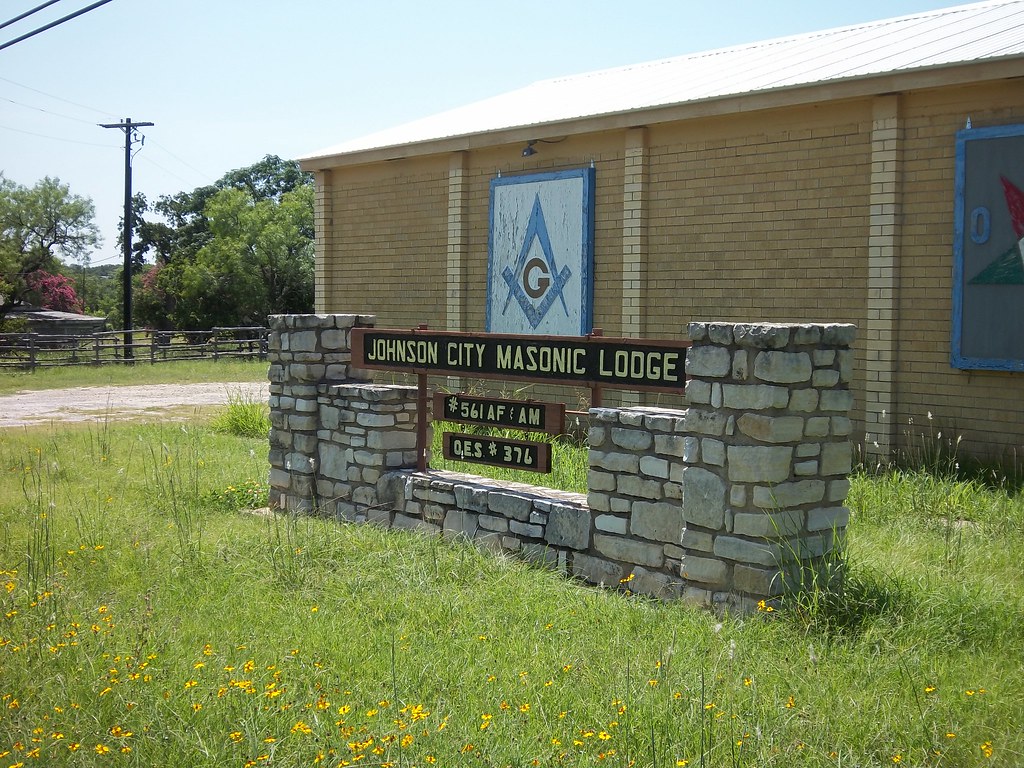
The first home. When the charter arrived in 1882, the brethren met in the first of their lodge buildings. Its stone remnants still stand — a quiet outline on the ground where Lodge No. 561 first opened on the Square and Compasses.
The second home. In time the lodge raised a second building, and met there for many years. It was lost to fire.
The third home. In 1951 the brethren built again — this time on US-290 West. For seventy-four years that building was our home and our challenge: a place that held our minute books, our degree work, our suppers, our funerals, our long evenings of fellowship. In 2025 the brethren voted to sell it and to build again.
The fourth home. Our fourth lodge building is rising now on the cemetery property our predecessors purchased in 1892 — the ground William McCarty helped make possible by founding the lodge, and Joseph Bird, W. H. Withers, and G. M. Nash made possible by deed three years after his death. The fourth building of Lodge No. 561 will stand on the soil of the first cemetery our brethren ever owned.
Four buildings. One lodge. The brethren who meet inside it are the lodge — and they have always been.
2025
A New Chapter, on Old Ground
For seventy-four years, the brethren of Lodge No. 561 met in our third lodge building on US-290 West — the one built in 1951 by the generation before us. It became both our home and our challenge. In 2025, after careful deliberation, the brethren voted to sell it and to construct a fourth lodge home on the very ground our predecessors purchased in 1892 — the Masonic Cemetery property.
We are not merely relocating. We are returning to the soil our forebears chose, and beginning the next chapter of the lodge's work where its second century began.
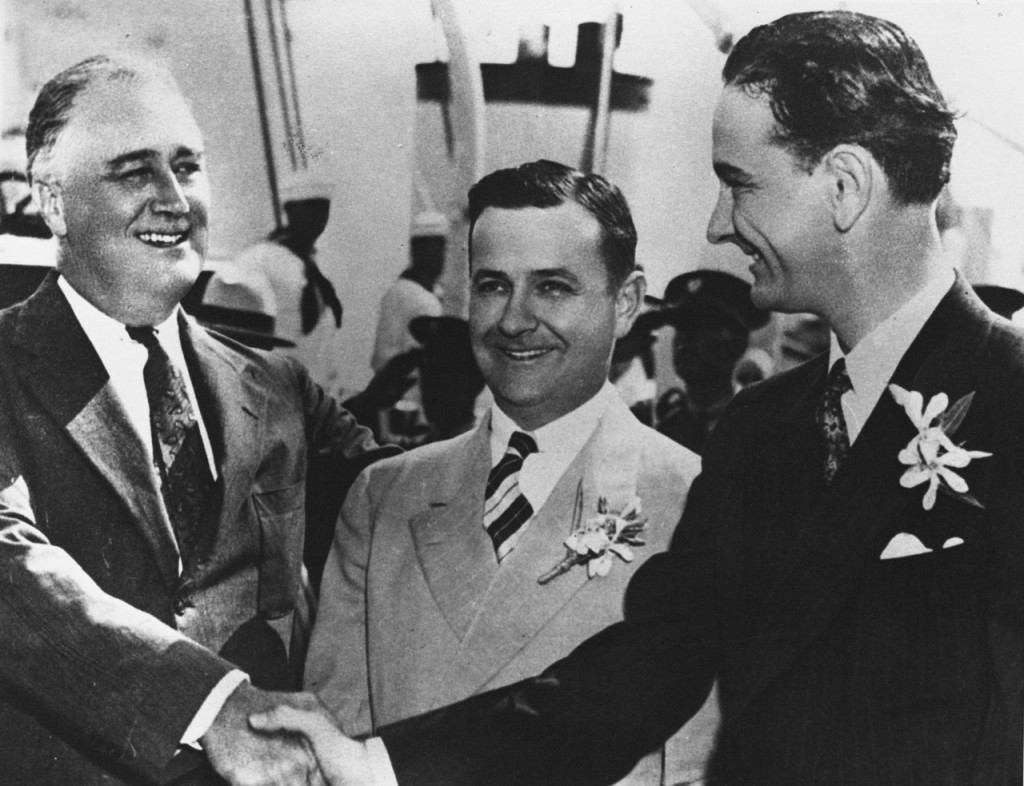
Photograph: Franklin D. Roosevelt Presidential Library / National Archives. Public domain.
October 30, 1937
A President at the Altar
On October 30, 1937, a young Hill Country congressman named Lyndon Baines Johnson was initiated an Entered Apprentice in this lodge. He never advanced to the Fellowcraft or Master Mason degrees, but the record of his initiation in our minute book remains — one Texan, in his home lodge, taking the first step that thousands of his neighbors had taken before and since.
He had been sworn in to the U.S. House of Representatives only six months earlier, representing Texas's 10th District. Twenty-six years later he would take the oath of office as the 36th President of the United States.
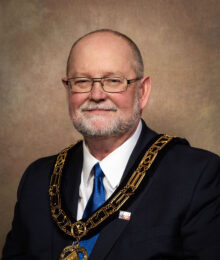
Photograph: Grand Lodge of Texas, A.F. & A.M. (official Grand Master portrait, 2020).
2020–2021
Our Past Grand Master
Right Worshipful Brother Paul D. Underwood, a Past Worshipful Master of Johnson City Lodge No. 561, was installed in 2020 as the 185th Grand Master of Masons in Texas — the presiding officer of the Grand Lodge of Texas, A.F. & A.M., the body that oversees nearly eighty thousand Master Masons in some seven hundred and seventy subordinate lodges across this state.
That a working country lodge of sixty-seven members produced a Grand Master is the kind of unlikely sentence the Hill Country specializes in. We say it plainly: he is ours, and we are proud of him.
From the Masonic Home to the Grand East
Paul Underwood's father died when he was four years old. At ten, he and his two older brothers entered the Masonic Home and School of Texas in Fort Worth — the home Texas Masons built and have sustained since 1899 to care for the children of brethren who could no longer care for them. He was raised there. He attended its schools, played its sports, and graduated from its high school. He has often said in the years since that he was a "silent beneficiary of Masonry" long before he understood what the fraternity was.
He went on to college, became an accountant by trade, and on July 9, 1973, at the age of twenty-one, was raised a Master Mason — in the Texas tradition that has always pulled its leaders from its own children. He affiliated with Johnson City Lodge No. 561 in the years that followed, served the lodge in its line of officers, and presided in the East as Worshipful Master.
He is the fourth alumnus of the Masonic Home and School ever to be elected Grand Master of Texas. The orphan child the lodges of Texas raised, in time, presided over them all.
"I have always tried to give back."
— R.W. Paul D. Underwood, often.
A Term Unlike Any Other
His progress through the Grand Lodge line was steady: Junior Grand Warden in 2017, Senior Grand Warden in 2018, Deputy Grand Master in 2019, and elected Grand Master in late 2020. Almost the moment he took the East, the COVID‑19 pandemic closed it.
For the first time in living memory, Texas lodges suspended stated and called meetings. Degree work paused. Fellowship halls went dark. He led the Craft through it — issuing edicts on safe practice, authorizing temporary dispensations so that brethren could be raised under safe conditions, and overseeing the rapid adoption of livestreaming and remote participation that allowed Grand Lodge proceedings to continue when in-person meetings could not. Lodges across the state still reference the Grand Master's pandemic-era proclamations in their minutes from those years.
Other Honors and Service
- Member of Al Amin Shriners, Corpus Christi, since 1994 — served as Potentate in 2015.
- Past President of the Masonic Ex‑Students Association of Texas (2008); served five years on the Board of Directors of the Masonic Home and School, including as Vice President and Treasurer.
- Recipient of two Golden Trowel Awards, the Texas Mason's recognition for distinguished service to the Craft.
- Twenty-five and forty-year service awards.
Freemasonry asks the same thing of every brother — that he spend his life laboring to become the best of what he was made to be. For some men that labor bears its fruit in business or in the trades; for some in the raising of children, the building of a marriage, the long faithful service of a congregation; for some in the quiet work of helping a neighbor through a hard year. For one of our brethren in our own lifetime, it bore fruit in the Grand East of the Grand Lodge of Texas. The Craft has room for both the quiet and the consequential. It asks the same thing of each.